Room to Grow: An Elasticity Test for UK Brand Narratives
Most UK brand narratives are commissioned for a particular moment: a funding announcement, a repositioning, a flagship launch or a change of leadership. They are written to sound complete. That completeness is often the source of later difficulty. When the next product, market, crisis or strategic shift arrives, the story has little room to move. Teams either force the new reality into old language or set the narrative aside and start again. Both outcomes are expensive.
The Greek term apeiron, often translated as the boundless or indefinite, offers a useful counterweight. It does not mean that a brand story should say everything or mean anything. It means designing a narrative with deliberate capacity to extend, so that growth adds chapters rather than cracks the spine. For UK in-house teams operating in crowded markets and under close scrutiny, that distinction matters.
Rigidity is rarely visible at launch
A narrative that is too tight usually looks like good discipline on the day it is approved. The language is crisp. The proof points are aligned. The leadership team agrees. The difficulty emerges six or twelve months later, when a new product line needs to sit inside the story, a regional team wants to adapt it, or a public issue demands a response that the original wording cannot accommodate.
At that point, teams tend to make one of three moves. They stretch the existing language until it becomes vague. They create a separate narrative for the new activity, which fragments the brand. Or they commission a rewrite, which consumes time and political capital. An elasticity test is designed to surface those risks before they become live problems.
The aim is not to produce an infinitely flexible story. A narrative with no fixed points is not elastic; it is merely loose. The test separates what must remain constant from what can adapt, and it gives teams a shared language for deciding which is which.
The three zones of an elastic narrative
A useful starting point is to sort the narrative into three zones.
- The invariant core. This is the promise or point of view that must remain true in any plausible future. It should be short enough to remember and specific enough to constrain behaviour. If it can be swapped without anyone noticing, it is probably not a core.
- The elastic middle. These are the themes, proof points and examples that can be expanded, reordered or replaced as the business grows. They give the story range without changing its underlying logic.
- The expendable edge. This is campaign language, seasonal phrasing and tactical detail that should be allowed to change. Keeping the edge light is a sign of confidence, not a lack of rigour.
Most narrative problems begin when teams confuse the zones. A campaign line is treated as a core belief. A core belief is treated as a tagline. The elasticity test makes those misclassifications visible.
A 90-minute workshop for UK in-house teams
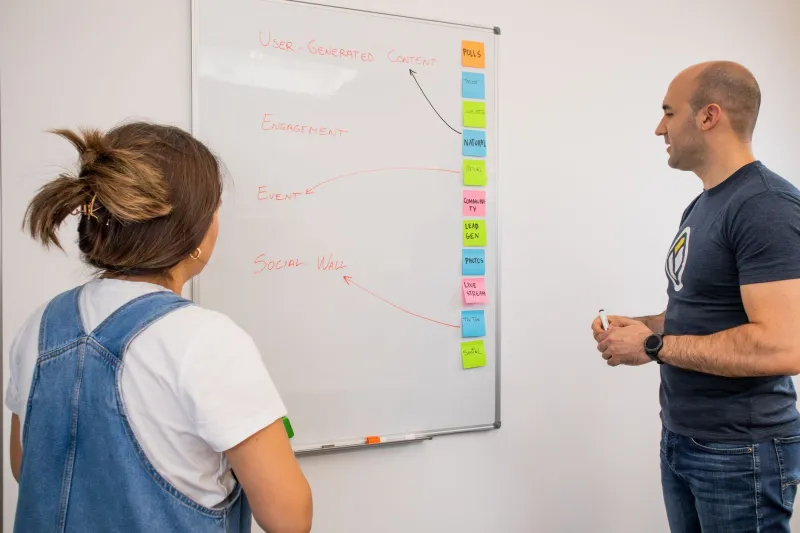
The format below is designed for a small group of five to seven people. It works best with a mix of communications, marketing, commercial and people functions, plus legal or regulatory input where relevant. UK teams often operate through matrixed approval, so inviting those who will later have to defend the story is more useful than keeping the session within the communications function.
Ask participants to read the current narrative and one recent example of it in use before the session. The workshop itself can run in 90 minutes.
1. Recover the invariant core (15 minutes)
Each participant writes three sentences that they believe must remain true regardless of new products, markets or leadership. Compare the sentences and consolidate them into a single draft core of no more than 40 words. If the group cannot agree, that disagreement is the first finding, not a failure of the exercise.
2. Map the zones (15 minutes)
Place the current narrative language into the three zones: invariant core, elastic middle and expendable edge. Expect debate. The purpose is not to produce a perfect taxonomy but to expose where the team is relying on language that cannot bear the weight being placed on it.
3. Run three future scenarios (40 minutes)
For each scenario, ask three questions: what stays, what stretches and what breaks? Record the answers on a shared board. A simple one-to-five scale for strain is enough; the discussion matters more than the score.
Scenario one: expansion. A new product, service or customer segment is added, or the business enters a new UK region or international market. Would the core promise still make sense to a customer in Manchester, Cardiff and Munich? Would the elastic middle provide enough proof, or would the team need to invent a parallel story?
Scenario two: reputational or regulatory shock. A supplier failure, an employment issue, a CMA inquiry or a critical media story puts the narrative under pressure. Does the story help leaders explain what the organisation is doing, or does it sound evasive? A narrative that cannot survive scrutiny is not a narrative; it is a fair-weather slogan.
Scenario three: strategic change. A new chief executive, an acquisition, a divestment or a significant shift in regulation changes the shape of the business. Would the current story still describe the organisation accurately, or would it require a rewrite within the first quarter? The answer often reveals whether the narrative was built around the business or around a single leader.
4. Decide the repairs (20 minutes)
For every break identified, agree one practical repair. That might be a new proof point, a permission statement that allows regional teams to adapt the language, a spokesperson guide for difficult questions, or a decision to retire a phrase that is doing too much work. Record the owner and the review date. An elasticity test without repairs is only a discussion.
Reading the results
The output is rarely a new narrative. More often it is a set of adjustments that make the existing one more durable. Three patterns are common.
If the core changes in every scenario, it is probably too narrow. It may be describing a product or a moment rather than a durable point of view. If nothing strains in any scenario, the narrative may be too vague to guide decisions. If only the expendable edge breaks, the story is in reasonable health and the team can focus on campaign discipline rather than a rewrite.
The most useful outcome is a short list of language that must be protected and a longer list of language that can be released. That distinction gives UK teams a clearer basis for approving campaigns, briefing agencies and handling media questions without reopening the entire narrative each time.
Keeping elasticity after the workshop
Elasticity is not a one-off exercise. It is a maintenance habit. A short review at each major planning cycle, or before a significant launch, is usually enough. The questions remain the same: what is core, what is flexible and what has become brittle?
Apeiron is sometimes treated as a philosophical curiosity, but the practical lesson is straightforward. A story that is designed only for the present will eventually be asked to carry a future it was never built for. A story with deliberate room to grow can absorb new evidence, new markets and unwelcome events without losing its shape. For UK brands operating in 2026 and beyond, that is not a luxury. It is a condition of staying coherent.